Two Best Poster Awards for LAAS-CNRS!
At the annual PEPR Électronique conference held on 18 and 19 March in Lyon, two Best Poster Awards were presented to Rachel Grosset Darracq and Pomme Hirshauer.
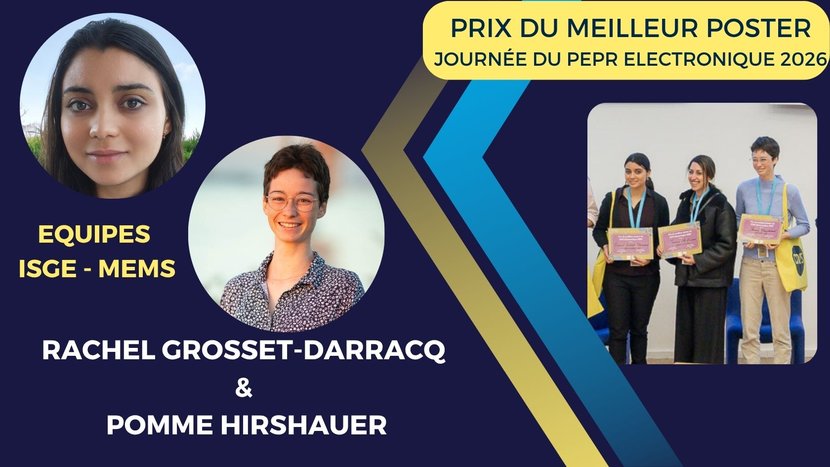
On March 18–19, 2026, the annual PEPR Electronics Days brought together over 350 participants in Lyon. During the event, around a hundred 60-second flash presentations introduced as many posters, followed by an open discussion session.
Following a vote by the participants, Pomme HIRSCHAUER (postdoctoral researcher in MEMS team on the RESISTE project) and Rachel GROSSET DARRACQ (PhD student in ISGE team on the FRENCHDIAM project) were selected among the top 10 posters.
Rachel Grosset Daracq presented her poster on the FrenchDiam project. This project aims to harness the exceptional properties of diamond, such as its ability to withstand high electric fields, its resistance to high temperatures and its outstanding thermal conductivity. It demonstrates the feasibility of two complementary advanced diamond devices: a high-voltage vertical transistor and a monolithic switching cell.
The poster entitled ‘Voltage withstand of diamond Schottky diodes: impact of crystal defects and optimisation of field plate protection’ presents an analytical methodology based on several characterisation techniques (primarily on the LAAS PROOF platform) to clarify the link between material defects and diode performance (photoluminescence, cathodoluminescence, IR thermography, OBIC). The architecture proposed in this study achieved a breakdown voltage of 680 V, close to the results reported in the literature for similar structures. Proposals for optimisation via simulation and improvements to cleanroom fabrication processes (Renatech LAAS facility) are discussed with a view to pushing this limit further for future diodes.
Pomme Hirshauer presented a poster on the RESISTE project. This project focuses on the development of microsystem sensors for use in harsh environments, designed to withstand challenging conditions. The poster’s theme was “Exploiting chaotic behaviour in vibrating MEMS sensors”. In it, she presents a new detection method suited to harsh environments. Indeed, chaos, better known as the butterfly effect, is highly sensitive, but its unpredictable nature has, until now, deterred scientists from exploiting this sensitivity. Here, we demonstrate that it can be used in a reproducible manner to detect variations in the gaseous environment. This novel and original detection approach can be applied to many types of sensors and applications, making this work a pioneering contribution to the field.
Congratulations to them!
isge / mems / Rachel Grosset Darracq / Pomme Hirschauer
published on 21.04.26