Seminar: Structure and Design of Optimization Algorithms
- Debut :
- 24 novembre 2026 10:30
- Fin :
- 24 novembre 2026 11:30
- Lieu :
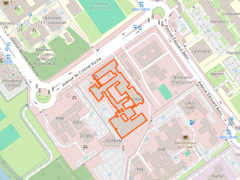
- LAAS-CNRS - Salle Europe 7 avenue du Colonel Roche 31077 TOULOUSE Cedex 4
- Unités :
- mac
- Mots clefs :
- Optimization, Control Theory
Intervenants
Jared Miller, Dr., University of Stuttgart, Germany
Jared Miller is currently a Postdoctoral Researcher at the Chair of Mathematical Systems Theory at the University of Stuttgart working with Prof. Carsten Scherer. He received his B.S. and M.S. degrees in Electrical Engineering from Northeastern University in 2018, and his Ph.D. degree from Northeastern University in 2023 under the advisorship of Mario Sznaier (Robust Systems Laboratory). He was previously a Postdoctoral Researcher with the Automatic Control Laboratory (IfA) at ETH Zurich in the research group of Prof. Roy S. Smith. He is a recipient of a 2020 Chateaubriand Fellowship, for which he visited the MAC team in LAAS-CNRS from February-August, 2022. His research interests include control of electric motors, design of optimization algorithms, and safety of nonlinear systems.
Résumé
Many common optimization algorithms can be interpreted as the interconnection of linear systems and operator nonlinearities (e.g. gradient descent, ADMM, Douglas-Rachford). This dynamical systems formulation allows for the analysis and synthesis of optimization algorithms by solving robust control problems. In this work, we form a link between convergence properties of nonlinear optimization algorithms and the regulation theory of linear dynamical systems. We show that the linear internal model principle in control theory applies in this specific nonlinear setting. This permits us to structurally factorize convergent optimization algorithms into the cascade of a parameter-dependent controller and a parameter-independent internal model. The regulation-theoretic interpretation of algorithm convergence extends to posing convergence properties for optimization algorithms operating in dynamic environments (e.g., time delays, channel memory, switching, or crosstalk). Multicriteria analysis and design of these algorithms proceeds by solving convex semidefinite programs subject to these structural constraints.
Abstract
Many common optimization algorithms can be interpreted as the interconnection of linear systems and operator nonlinearities (e.g. gradient descent, ADMM, Douglas-Rachford). This dynamical systems formulation allows for the analysis and synthesis of optimization algorithms by solving robust control problems. In this work, we form a link between convergence properties of nonlinear optimization algorithms and the regulation theory of linear dynamical systems. We show that the linear internal model principle in control theory applies in this specific nonlinear setting. This permits us to structurally factorize convergent optimization algorithms into the cascade of a parameter-dependent controller and a parameter-independent internal model. The regulation-theoretic interpretation of algorithm convergence extends to posing convergence properties for optimization algorithms operating in dynamic environments (e.g., time delays, channel memory, switching, or crosstalk). Multicriteria analysis and design of these algorithms proceeds by solving convex semidefinite programs subject to these structural constraints.