Two Awards for Research on Malaria Resistance for Emilie Guémas and Dulce Trejo !
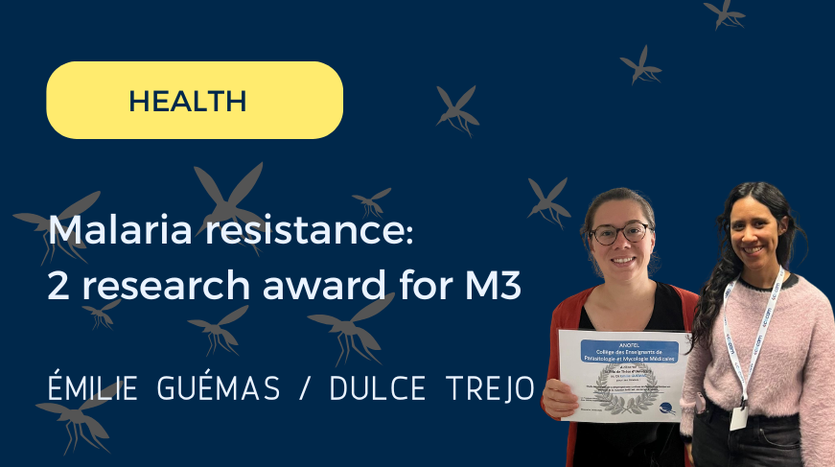
Emilie Guémas and Dulce Trejo from the M3 team have been recognised for their work on malaria resistance
Malaria remains a major public health issue in tropical regions, causing more than half a million deaths worldwide each year. In Africa, where most cases occur, children under the age of five and pregnant women are the most affected populations, and the parasite Plasmodium falciparum is responsible for most malaria-related deaths.
In addition, the emergence of resistance-associated mutations threatens the effectiveness of current chemoprevention strategies. Through an integrated approach developed over several years of collaboration between LAAS and INFINITY, researchers aim to better understand the effects of mutations on dihydropteroate synthase (DHPS), a therapeutic target of P. falciparum. This project is currently supported by the ANR SULPAR program.

On November 24, 2025, Emilie Guémas defended her PhD thesis entitled: “Study of Plasmodium falciparumdihydropteroate synthase mutants carrying the Ile431Val mutation: from field to atom.” For this work, she received the thesis award presented annually by the ANOFEL society in Paris on March 24, 2026.
During her PhD, Emilie Guémas investigated the emergence of a new mutation (Ile431Val) in the pfdhps gene of Plasmodium falciparum, involved in resistance mechanisms, as well as the accumulation of mutations threatening treatment efficacy. To address these questions, she combined several methodologies: field approaches (sequencing African samples), epidemiological data analyses to monitor the spread of this mutation across Africa and understand its impact on drug resistance through enzymatic studies, as well as molecular simulations linking mutations, enzyme structure, and resistance.

On March 27, 2026, in Lausanne, Dulce Trejo received the Best Poster Award at the CECAM school “Hybrid Quantum Mechanics / Molecular Mechanics Approaches to Biochemistry and Beyond”. This international school brought together 82 participants from 26 countries.
The work she presented focuses on elucidating the catalytic activity of the PfDHPS enzyme, a fundamental prerequisite for deciphering the complex relationship between structure and catalysis that emerges in mutant systems associated with antimalarial resistance.
To achieve this, Dulce Trejo uses various atomistic simulation methods, combining molecular dynamics and quantum approaches. The goal is to contribute to the design of new PfDHPS inhibitors capable of overcoming resistance and acting as future antimalarial drugs.
published on 22.05.26