Better Identification of Atomic Defects in Crystals Using Quantum Computation
Accurately identifying point defects in a crystal is a major challenge for microelectronics and emerging quantum technologies, where a single misplaced atom can make all the difference.
In a crystal, microscopic imperfections—known as point defects—play a decisive role in the performance of electronic components and future quantum devices. Identifying them with precision is a major challenge for microelectronics and emerging quantum technologies, where a single misplaced atom can change everything.
Electron paramagnetic resonance (EPR) is one of the most powerful techniques for reading the magnetic fingerprint of these defects. Among the quantities it measures, the g-tensor is particularly informative: it is, in a sense, a defect’s magnetic “ID card,” reflecting its symmetry, electronic structure, and local environment. But to fully exploit this information, it must be calculated based on the laws of quantum physics.
Existing computational methods suffered from two limitations. On the one hand, they became numerically unstable as soon as simulations reached the scale necessary to accurately describe a real defect in a crystal. On the other hand, the available codes were outdated and poorly integrated into modern computing environments—making their use difficult, if not impossible, for most researchers.
This work removes this dual barrier in a concrete and sustainable way through the development of QE-CONVERSE—a completely redesigned, open-source computational code. Built on a solid foundation and integrated with Quantum ESPRESSO—an open-source quantum materials simulation software used by the international community— QE-CONVERSE is a tool that is robust, fast, and accessible, enabling the calculation of the g-tensor for real defects—in supercells containing up to a thousand atoms—with unprecedented precision and stability, and at a computational cost compatible with routine use.
By making this code freely available, this work goes beyond simply producing scientific results: it provides a lasting resource for the research community working on materials for advanced microelectronics, quantum sensors, or defect-based qubits in semiconductor materials.
This work by Anne Hémeryck and Simone Fioccola of the Multiscale Materials Modeling (M3) team was published in the journal npj computational materials. It is the subject of an article on the CNRS Ingénierie website.
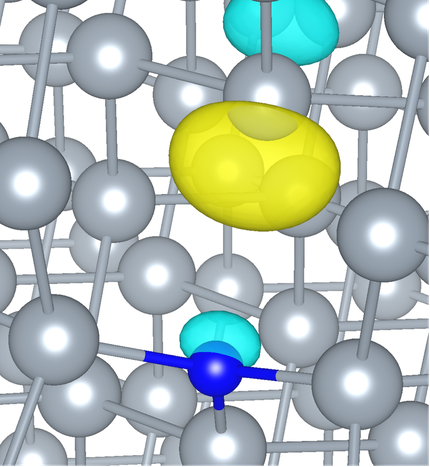
Legend : Spin-density isosurface of the substitutional nitrogen defect in silicon. The unpaired electron is mainly localized on the dangling bond of the silicon atom along the ⟨111⟩ direction, with a smaller contribution on the nitrogen atom.
© Simone FIOCCOLA, LAAS-CNRS.
published on 15.07.26